
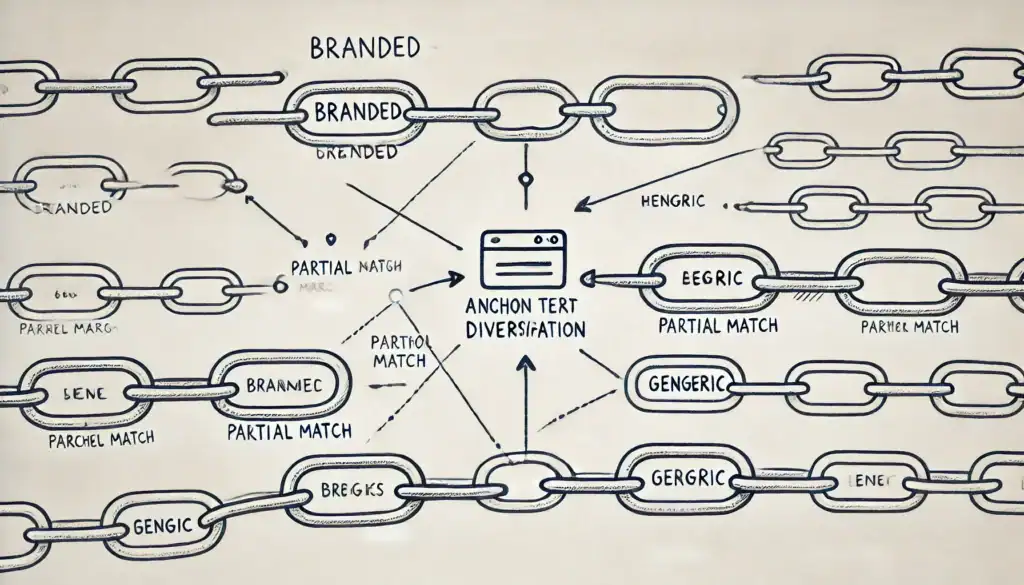
In this post, you’ll learn how to build a strong link-building strategy using anchor text diversification. This simply means mixing up the words you use for links pointing to your website. We’ll cover different types of anchor text—like branded, partial match, and generic—and explain why it’s important to keep things natural so search engines see your links as legit
When choosing anchor text for inbound links, it’s crucial to balance relevance, diversity, and naturalness to avoid penalties from search engines like Google. Here’s a guide on the fundamentals and how to create a good mix of anchor text for natural-looking backlinks:
1. Exact Match Anchor Text
- Definition: The anchor text exactly matches the keyword you’re trying to rank for.
- Use Sparingly: Although exact match anchor text can be powerful, overuse can appear manipulative and lead to penalties. Limit this to around 5-10% of your backlink profile.
2. Partial Match Anchor Text
- Definition: The anchor text includes the target keyword along with other words.
- Example: If your keyword is “digital marketing services,” a partial match could be “affordable digital marketing services.”
- Use More Often: This is safer and more natural than exact match and should make up around 20-30% of your backlink profile.
3. Branded Anchor Text
- Definition: The anchor text is the name of your business or brand.
- Example: “Tamarindo Guide.”
- Best Practice: Branded anchor text is safe and should be a large part of your profile (30-40%) since it looks natural to both users and search engines.
4. Naked URL Anchor Text
- Definition: The anchor text is the actual URL of your website.
- Example: “www.tamarindoguide.com.”
- Purpose: This signals transparency and natural linking, and it can help diversify your link profile. It should make up around 10-15% of your backlinks.
5. Generic Anchor Text
- Definition: The anchor text includes generic terms like “click here,” “learn more,” or “this website.”
- Natural Feel: These appear more organic and are often used by people linking naturally. This can make up 10-15% of your backlink profile.
6. Long-Tail Anchor Text
- Definition: The anchor text is a longer phrase that could include variations or questions.
- Example: “Learn about the best web design and digital marketing services in Tamarindo.”
- Natural Linking: This resembles how natural links are often created by publishers and should be around 10-15% of your backlink profile.
7. LSI (Latent Semantic Indexing) Keywords
- Definition: These are semantically related keywords instead of the exact match keyword.
- Example: If your target keyword is “web design services,” an LSI keyword could be “online site development solutions.”
- Search Variety: This can help capture more search intents and improve keyword diversity, comprising 5-10% of your profile.
A Good Mix of Anchor Text
- Exact Match: 5-10%
- Partial Match: 20-30%
- Branded: 30-40%
- Naked URLs: 10-15%
- Generic: 10-15%
- Long-Tail and LSI: 10-15%
Key Takeaways:
- Diversity is essential. A natural link profile contains various types of anchor text.
- Avoid patterns in anchor text distribution. If all links follow the same pattern (e.g., lots of exact matches), it may look suspicious to search engines.
- Relevance: Ensure the links come from content that’s relevant to your niche and website. This helps boost the authority more effectively.
By following these guidelines, you can build a natural-looking link profile that strengthens your domain authority while minimizing risks.